
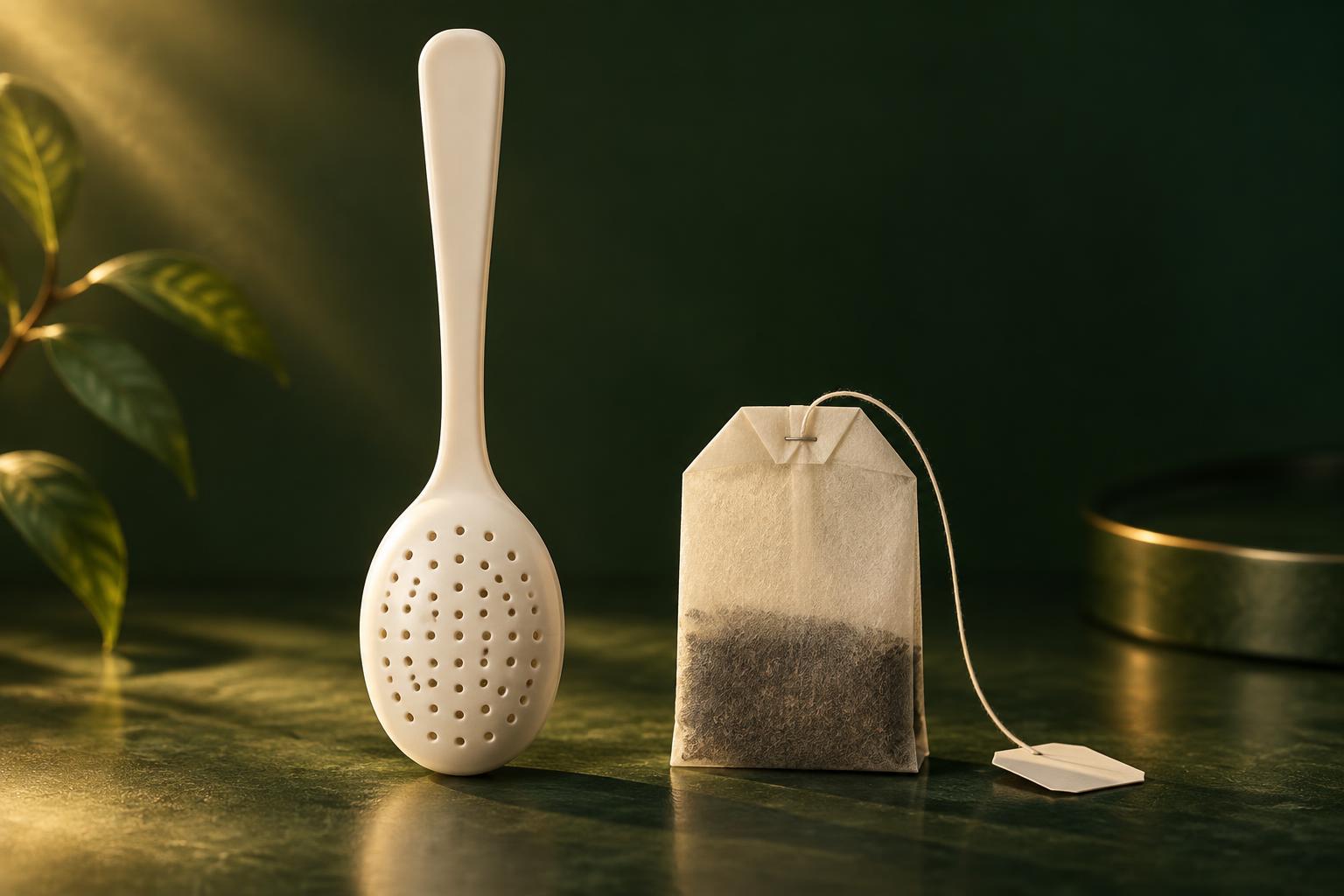
The tea bag turned a hundred years old without changing much. It is still a paper pouch, a string, and a promise — and for most of its life, that promise has been quietly broken. Spoon Tea was built as the answer to a simple question: what if the format respected the leaf as much as the drinker? This is an honest look at how the two compare, point by point.
What's actually inside
Open a standard tea bag and you will usually find dust and fannings — the smallest grades of tea, the particles left after whole leaves are sorted for better uses. They brew fast because they are mostly surface, and they taste flat for the same reason. Open a One Way spoon and you find whole and broken leaves, the same grades a good loose-leaf tin would carry, sealed at the moment of packing. The difference is visible before any water is poured.
What happens in the cup
A paper bag constrains the leaf. It sits compressed in a tight pouch, barely room to unfold, steeping unevenly — over-extracted on the outside, untouched at the core. The One Way spoon gives the leaves a ventilated chamber with room to open fully, so the water moves through them the way it would in a proper infuser. The result is a layered cup instead of a one-note one: top notes, body, and a clean finish, in under three minutes.
Freshness over time
Light, air and moisture are the enemies of tea, and most bags surrender to all three on a warehouse shelf. Boxes are opened, sachets sit exposed, and the tea that reaches your kitchen is rarely the tea that left the estate. Each One Way spoon is individually sealed against light, air and moisture, so the last spoon in the box brews exactly like the first — months later, in any climate.
The small indignities
Anyone who drinks bag tea knows the choreography: the dripping bag looking for a saucer, the string slipping into the cup, the stained spoon, the wet pouch squeezed against the rim. The spoon removes the whole routine. It is the measure, the infuser and the stirrer in one sealed object. You lift it out cleanly, and the only thing left in the cup is tea.
What about the waste?
A surprising number of 'paper' tea bags are heat-sealed with plastic, and silky pyramid sachets are often plastic entirely — shedding microplastics into hot water and lingering in landfills for decades. The One Way spoon is engineered as a single contained unit: no string, no tag, no glue-sealed paper, and no filter shedding anything into your drink.
Where each one wins
To be fair: the tea bag wins on ubiquity and shelf price. It is everywhere, and it is cheap. But price per cup is not the same as value per cup. If you care about what the leaf tastes like, how fresh it is, and how the ritual feels — at home, at the office, or in a hotel room — the spoon is the better cup by a wide margin.
The verdict
Tea bags were a clever answer to a 1920s question. Spoon Tea is the answer to today's: premium leaves, exact dosing, sealed freshness and zero mess, in one object that fits in a pocket. Taste the difference for yourself in the One Way collection.